Field notes
Reading the migration, not chasing it
Everyone wants to see the river crossing. Fewer understand what actually decides where a million and a half wildebeest will be on the morning you arrive.
The single most common request we receive is some version of: “Book us for the crossing.” It is an understandable ask — the Mara River crossing is one of the few wildlife events that has genuinely earned its reputation. But it is worth being honest about what the migration is, because the honesty is what lets us plan a trip that actually delivers.
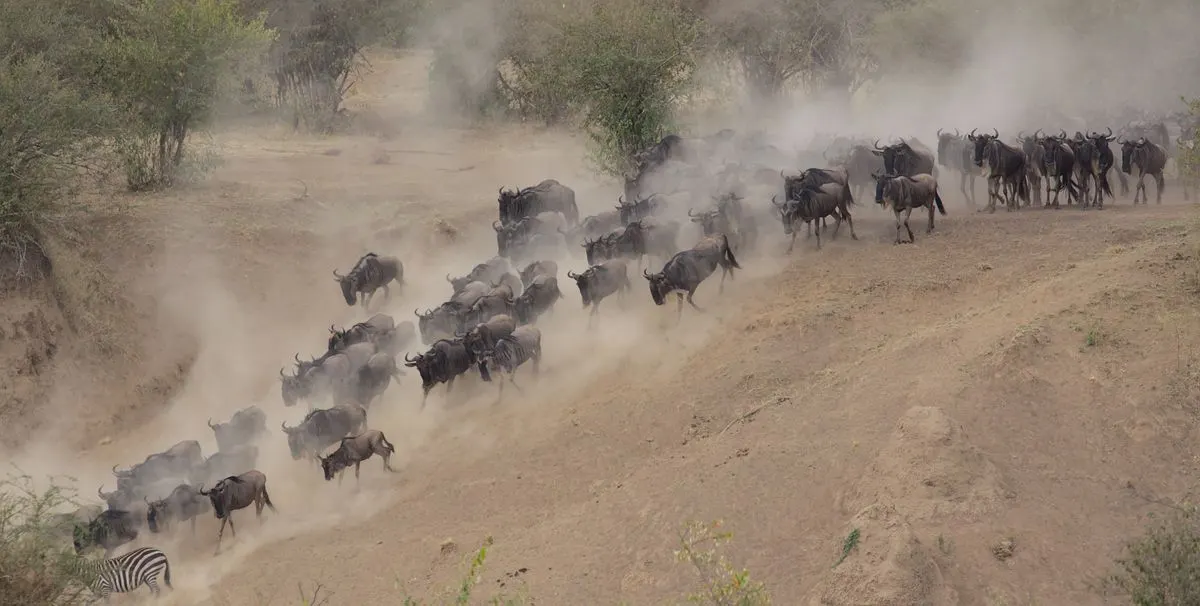
The Great Migration is not an event. It is a year-round, roughly circular movement of around 1.5 million wildebeest, several hundred thousand zebra, and a long tail of gazelle, following fresh grazing across the Serengeti–Mara ecosystem. There is no start line and no finish line. The herds are always somewhere. The only question that matters for your trip is: where, in the month you can travel?
It follows rain, not the calendar
Grass grows where it has rained. Wildebeest move to the grass. That is the entire mechanism, and it is why a fixed “migration season” is a marketing convenience rather than a fact. A late short-rains season can hold the herds south for weeks past the dates a brochure quotes; an early dry spell can push them north ahead of schedule. We have watched a crossing happen in a year everyone called “too early,” and watched a river sit empty in what should have been peak week.
The herds do not read the brochure. They read the sky, two hundred kilometres away, three weeks ago.
What this means in practice is that we plan around probability and region, not around a promised spectacle on a promised day. As a broad rule of thumb — and it is only that:
- December to March: the herds are on the southern Serengeti short-grass plains. This is the calving season — hundreds of thousands of births in a few weeks, and the predator action that follows.
- April to May: the long rains, and the herds begin moving north and west. Fewer travellers, green landscapes, lower rates — and genuinely unpredictable.
- June to July: the western corridor and the Grumeti, then the push toward the Mara.
- July to October: the herds are in and around the Masai Mara and northern Serengeti — the window in which Mara River crossings are most likely.
How we actually plan for it
First, we put you in the right region for your dates, not the famous one. If you can only travel in February, we do not send you to a quiet Mara and call it bad luck — we send you to the calving grounds, where February is the best show on earth. Second, we build in nights, not a night. A crossing is a matter of hours of readiness and, often, several days of waiting; three or four nights in the right area turns a coin-flip into a strong probability. Third, we keep the plan flexible where the ecosystem allows it, so a guide who hears that the herds have massed at a particular bend can act on it.
And we manage expectations before you fly, not after. A river crossing is never guaranteed by anyone honest. What we can promise is that you will be in the right place at the right time of year, with a guide who reads the ground, and enough days to give the ecosystem a chance to do what it does. In our experience, that is exactly the trip people remember — not because they ticked a box, but because they stopped chasing and started watching.
Continue reading
- PracticalWhat vegetarian actually means in a bush kitchenMost camps will say yes. Fewer understand what the question is really asking.Read
- Family travelThree generations, one vehiclePlanning a safari that works for a nine-year-old and a seventy-nine-year-old on the same drive.Read
- PhotographyThe light before sixWhy the first ninety minutes decide whether you come home with photographs or snapshots.Read
The fire is lit
Ready to Begin Your African Adventure?
Speak with our safari experts and let us design a journey you will remember for a lifetime — the route, the camps, and an honest view of what the season will give you.
No obligation · Personal reply within 24 hours · Tailor-made for your family
Peak migration season (July–October) fills months in advance — the best camps go first. If you are thinking about next year, now is the time to talk.